

Reconceptualizing Decentralized Energy Autonomy: A Doctoral-Level Analysis of the Lost Generator Framework- Best Self Help Books
The Structural Precarity of Centralized Energy Infrastructures
Contemporary societies are increasingly confronted with the escalating vulnerabilities inherent in centralized energy infrastructures. Rising utility costs, the fragility of aging grid systems, and the intensifying consequences of climate change—ranging from extreme storms to droughts and erratic weather disruptions—demonstrate the systemic precarity embedded in conventional energy paradigms. Incremental solutions, such as efficiency upgrades or fossil-fuel backup systems, provide only temporary relief and fail to resolve the core issue: an entrenched dependence on monopolized, centralized utilities that perpetuate economic fragility, ecological degradation, and diminished household autonomy.
This model cultivates structural reactivity, wherein individuals and communities remain perpetually dependent on external institutions rather than empowered to proactively secure their own energy futures. As geopolitical instability and climate uncertainty continue to destabilize global energy markets, the need for transformative, decentralized alternatives becomes more urgent. In this evolving discourse, energy sovereignty is emerging as both a pragmatic necessity and an ideological cornerstone of resilience and justice in the twenty-first century.
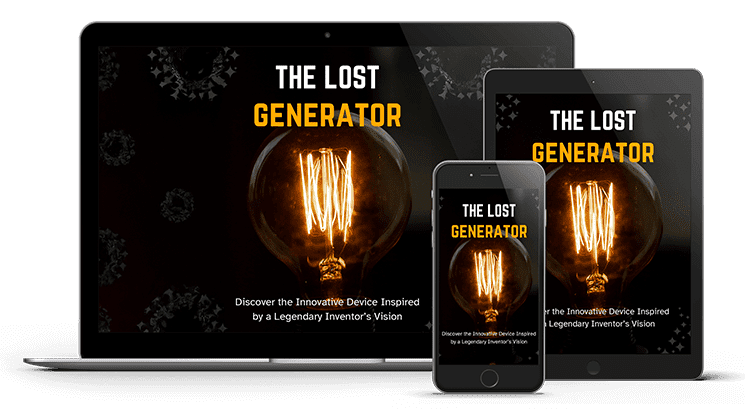
The Lost Generator as a Disruptive Intervention
The Lost Generator is positioned as a radical intervention that redefines how households interact with energy. Unlike corporate-controlled, proprietary technologies, it is presented as an accessible, do-it-yourself blueprint that enables individuals to construct a compact, renewable-based system for household electricity generation. Its central claim is both material and symbolic: that households can substantially reduce dependence on centralized utilities by producing their own renewable electricity, thereby reclaiming autonomy.
Core Benefits and Assertions
Economic Transformation and Long-Term Stability – By suggesting potential reductions in household energy costs of up to 80%, the Lost Generator situates itself not as a stopgap measure but as a structural economic strategy. In an era of rapidly escalating energy expenses, this promise resonates with households seeking predictability and financial security.
Democratization of Energy Access – The blueprint is deliberately framed as intuitive and accessible, enabling adoption beyond technical specialists. This democratization of energy production reframes energy independence as a broadly achievable goal, accessible to ordinary households rather than reserved for technical elites.
Environmental Sustainability and Climate Alignment – By eliminating reliance on carbon-intensive backup generators, the system affirms a commitment to sustainable, regenerative energy practices. Its orientation toward renewable forces positions it squarely within global discourses of ecological responsibility.
Resilience and Adaptive Security – As grid instability, cyber vulnerabilities, and market volatility continue to proliferate, decentralized systems such as the Lost Generator are presented as bulwarks of resilience. The system is marketed as protection against outages, escalating costs, and systemic fragility.
Household Sovereignty and Symbolic Autonomy – Beyond its technical claims, the generator embodies symbolic empowerment. It signifies a reassertion of household agency over the most essential modern resource—electricity.
Cultural and Ideological Significance
The Lost Generator is not solely a technological innovation; it functions simultaneously as a cultural artifact and ideological statement. It challenges the epistemic dominance of centralized utility providers while affirming narratives of independence, resilience, and liberation. Particularly in rural, remote, or marginalized communities, the device resonates as both a functional solution and a symbolic declaration of sovereignty.
By aligning itself with broader socio-political movements—ecological sustainability, distributive justice, and local resilience—the Lost Generator becomes more than an energy innovation. It emerges as a cultural manifesto that seeks to reimagine not only how energy is produced but also how power is redistributed within society.
Critical Appraisal: Aspirational Potential Versus Empirical Gaps
Despite its bold promises, the Lost Generator remains embedded in contested terrain. Its claims of near-limitless renewable energy production are undercut by the absence of peer-reviewed validation, standardized safety certifications, or verifiable efficiency data. This lack of empirical grounding justifies skepticism, highlighting the critical distinction between aspirational rhetoric and demonstrated technological efficacy.
By contrast, established renewable systems—such as photovoltaic solar panels, micro-wind turbines, geothermal systems, and advanced energy storage technologies—offer well-documented reliability and empirical validation. These technologies, though often more costly upfront, provide proven and scalable pathways toward decentralization. Thus, the Lost Generator should be understood less as a definitive solution and more as a provocative articulation of energy autonomy within a broader continuum of innovation.

Navigating Vision and Reality
The Lost Generator encapsulates the dialectic of contemporary energy innovation: it embodies both visionary aspiration and unresolved empirical uncertainty. Its cultural and symbolic resonance is undeniable, particularly among households seeking to liberate themselves from centralized grid dependence. Yet its technological reliability remains unverified, necessitating cautious optimism tempered with critical scrutiny.
For those prioritizing durable resilience, established renewable infrastructures remain the most reliable pathways to energy independence. Nevertheless, the Lost Generator contributes meaningfully to the discursive terrain by crystallizing cultural aspirations for autonomy, sustainability, and local sovereignty. Ultimately, energy systems must be understood not merely as technical configurations but as deeply political and cultural constructs. To reimagine them is to reimagine autonomy, justice, and resilience within the Anthropocene.
More others books on Best Self Help Books


 By
By
 huemsuvthu says: