

Aqua Tower: Engineering Water Resilience Through Atmospheric Harvesting
Water security has emerged as one of the most pressing engineering and societal challenges of the 21st century. Urban infrastructure is vulnerable to systemic failure, rural populations face increasing drought pressures, and households across geographies are discovering that utility costs can spike unpredictably. Within this context, the Aqua Tower presents itself not merely as a consumer product but as a distributed engineering solution—a portable, low-cost atmospheric water generator (AWG) built through structured do-it-yourself (DIY) methodologies.

The Underlying Challenge: Structural Vulnerabilities in Water Supply Systems
Conventional water delivery systems are characterized by three primary weaknesses:
Single-point dependency – A household’s sole reliance on municipal supply or a private well makes it acutely exposed to line breaks, pump failures, contamination incidents, or restrictive drought regulations.
Cost volatility – Water utilities adjust rates dynamically in response to infrastructure maintenance, scarcity events, or municipal deficits, leaving consumers with little control over pricing.
Storage fragility – Stockpiling water in tanks or containers creates a finite reserve subject to spoilage, microbial growth, and logistic limitations. Moreover, it is not inherently portable.
These vulnerabilities establish the need for redundant, self-contained, and portable water generation systems that do not rely solely on central utilities.
Engineering the Solution: Aqua Tower as an Atmospheric Water Generator
The Aqua Tower is designed as a low-barrier AWG system, leveraging fundamental principles of condensation, heat exchange, and filtration. The concept parallels the behavior of HVAC coils—moisture in the ambient air is condensed on cooled surfaces, collected, and purified into potable water.
System Specifications (as described in product documentation):
Output: Up to ~60 gallons/day (environmentally contingent on temperature and relative humidity).
Bill of Materials (BOM) cost: Approximately $200, with all parts sourced from conventional hardware suppliers.
Assembly time: Frequently reported as under one hour, though some documentation notes ~three hours for first-time builders.
Portability: Lightweight and adaptable, with an off-grid power integration option.
In engineering terms, this system offers distributed redundancy: a modular, localized unit capable of autonomous operation outside of centralized water infrastructure.
Target Use Cases and Beneficiary Profiles
From a systems-engineering lens, Aqua Tower serves multiple deployment environments:
Residential urban settings: As a backup subsystem, mitigating disruptions from boil advisories or municipal outages.
Rural and off-grid contexts: A primary or secondary water source, especially where borewell access is unreliable.
Emergency preparedness scenarios: A resilient fallback for households affected by storms, seismic events, or grid failures.
Mobile deployments: RVs, camps, or temporary relocations requiring transportable water production.
Functional Advantages Over Conventional Approaches
On-demand production – Unlike static storage, Aqua Tower generates potable water continuously, as long as humidity and power are available.
Economic optimization – By partially substituting municipal supply, users report cost reductions in the range of 30–90%, although actual results are climate-dependent.
System autonomy – With off-grid power integration, water generation remains functional even during prolonged blackouts.
Accessibility of design – Documentation ensures even non-engineers can construct the device using provided manuals, schematics, and video instructions. The offer includes unlimited technical support, reinforcing usability.

Deliverables Upon Acquisition
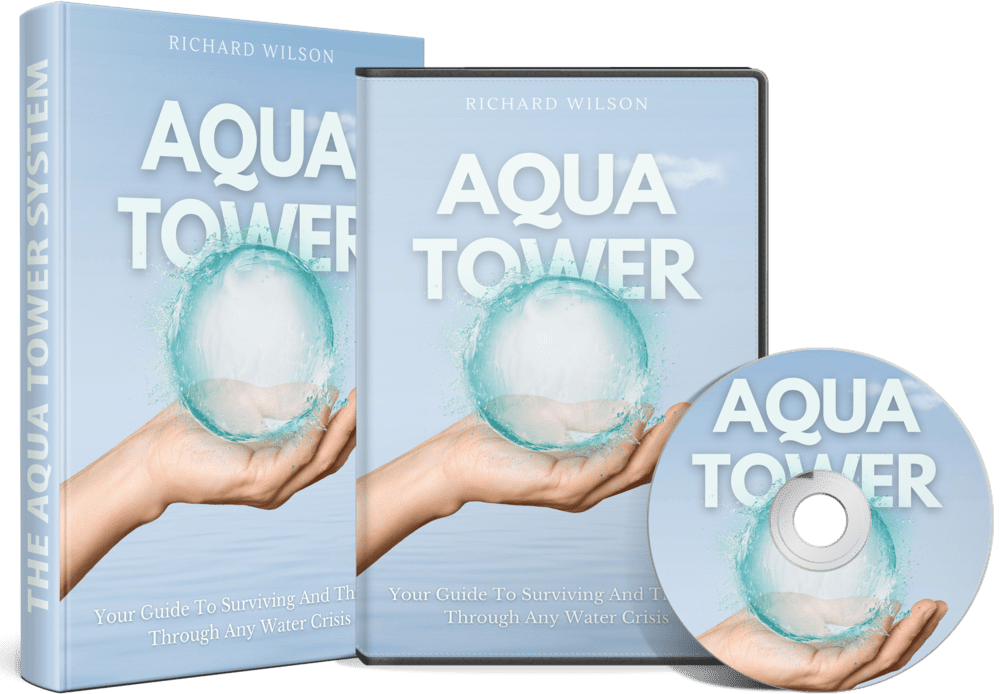
The Aqua Tower system is sold as a comprehensive instructional package, not as a pre-assembled unit. Purchasers receive:
Digital manual, schematics, and BOM.
Step-by-step instructional videos.
Optional physical book (print + digital) for redundancy in case digital access is disrupted.
Customer support via email.
Cost Structure:
Digital Package: $39.69
Digital + Physical: $39.69 + $8.99 shipping
Guarantee: 60-day full refund policy
Integration into Resilience Planning
In engineering practice, redundancy and resilience are key principles. Aqua Tower can be positioned as:
Primary fallback in urban households.
Augmentation for rainwater harvesting or well systems.
Scalable modularity—multiple units can be constructed to increase output.
Mobile resilience asset—portable enough for temporary displacement scenarios.
Construction Workflow: Engineering a Household-Scale AWG
Procurement – Collect components as per BOM.
Fabrication and assembly – Follow schematic and video guidance to build the core condensation and collection apparatus.
Power integration – Connect to either grid or off-grid energy source.
Commissioning – Conduct first-run performance test, calibrating for ambient conditions.
Maintenance – Minimal, periodic sanitation of collection pathways.
Anticipated User Queries
Climatic sensitivity: Output is significantly reduced in low-humidity, arid conditions. Optimization strategies include pairing with shaded or cooler environments.
Maintenance requirements: Limited; sanitation protocols are necessary for potable compliance.
Build time variability: Experienced builders report completion within an hour; novices may require three hours
Conclusion: Aqua Tower as an Engineering Response to Scarcity
From an engineering perspective, Aqua Tower represents a democratization of water technology—translating atmospheric harvesting principles into an accessible, reproducible system. For less than $50 in documentation and ~$200 in materials, households can achieve partial autonomy over one of life’s most critical resources. In a century marked by hydrological uncertainty, the Aqua Tower is not simply a product; it is an applied engineering intervention in domestic resilience.


 By
By